So for the first time in history a regular, competitive NFL game was played in London today. Some gang of jokers called the New York Giants against a bunch of wankers called the Miami Dolphins. Yeah, I hadn't heard of either of them either.
(I'm just kidding. When I was a boy a friend of mine got into American football, and his favourite team was the Miami Dolphins, so I had heard of them.)
I watched bits of it. It was...okay. Rugby with helmets, basically, but less free-flowing and consequently much less exciting. During the micro-seconds when they were actually playing the game, rather than standing around with their hands on their hips watching the dozens of referees do stuff, it was fun. I worked out what the whole point of it was, anyway. The main rule seems to be: if something exciting happens, stop.
The differences with rugby are that there are about a billion more players, they don't do nearly as much, you can throw the ball forwards, and you don't have to actually ground the ball to score. Also, for some reason it seems each team is obliged to have one fatso with a big pot belly, who patently has no place on a sports field of any description.
It didn't win me over as a fan, to be honest, but I'll watch any sport quite happily - even curling, for God's sake - so it passed the time. I have to wonder what the purpose of the whole thing was, though. It obviously raised a hell of a lot of money - the 90,000 seater was filled to capacity. But in terms of "growing the game" I think the NFL is on to a loser. We already have two versions of rugby, so the niche that American football occupies in the US is pretty much full to bursting in Britain. It'll always draw crowds because people are curious to see what all the fuss is about, but I think that's the most it can hope for when it comes to expanding its fan base overseas. If any American sport can succeed in the UK it's probably basketball, because it's different enough from our native games that it faces less competition.
That said, cheerleaders I could get used to.
Sunday, 28 October 2007
Rugby But With Helmets

Tuesday, 23 October 2007
Affirmative Silliness
Apparently there is big danger now for the Springboks: despite being the strongest team in the world, it seems that politicians and politicking might be about the seriously undermine their success by imposing racial quotas on team selection.
Let me come right out and say: I understand the arguments both for and against affirmative action, and I believe that it can have a place in a society which is highly divided racially. There is a case to be made that unspoken racial prejudices exist even in countries where legislation has made those attitudes illegal, and a way of fighting those prejudices is to enforce changes in the workforce.
But not sport - and, specifically, not the national team of a country. Why? Not because it could potentially weaken the side - which is true; nor because it is unfair to the supposedly 'favoured' race, in this case the whites - which is true too; but because it has the exact opposite effect to that which is intended.
There are already a lot of black rugby players in South Africa, many of them playing professionally. What is more, two of the Springboks' star players - JP Pietersen and Bryan Habana - are black. This goes to prove firstly that success in rugby has nothing to do with race, and secondly to prove that the team management is not governed by racial bias in selection.

But by imposing a quota, the government risks destroying everything that the Springboks' management - and, more importantly, brilliant talents like JP Pietersen and Bryan Habana - have done for black rugby in South Africa, because it will forever taint black players with the suspicion that they have been selected not because they are the best rugby players in the country, but because they are the best black rugby players in the country. Not only that. It will also forever be a backhanded insult to the black population of South Africa, labelling them unable to progress as world-class rugby talents without aid from the government.
JP Pietersen and Bryan Habana have proved that untrue. They've proved that in the space of 12 years, the Springboks have changed from a parochial, backwards-looking bulwark of apartheid into a modern, unbiased reflection of their nation's diversity. That organic change might be scuppered irreperably by the interference of stupid politicians, and I find that disgraceful.

Sunday, 14 October 2007
The Frogs or Les Rosbifs - That is the Question
I feel very conflicted about supporting English national sports teams. I was born in England, so it shouldn't be a problem, but my dad is a Scots-Irish Catholic from the slums of Glasgow - which, if you're not familiar with British politics, roughly translates as "English hater" - while my mum is Liverpool born-and-bred, which means her family came over from Ireland during the potato famine like most of the rest of the city's population; and like the rest of the city, they still identify more strongly with Ireland than England. So none of my blood is really English, I was born in an English city that is really a Celtic city, and my cultural roots are Catholic and Irish, which means I feel, at best, uncomfortable with English sport. Particularly since English sporting teams can be identified so readily with South-Eastern, red-faced, ale-swilling, brawl-loving, Cross of St. George-waving buffoonery of the highest order.
Motivating myself to support England against Australia is easy, because hatred of Australian sports teams - particularly the cricket team - is natural for anybody who is interested in sports that Australians play. And I can get behind England against Argentina. That taps into something primal; if there were ever two nations that could be described as having a personality clash, it's Britain and Argentina, and my blood is equally fired by England, Scotland, Wales, whoever, if it's against the Argies.
But when England play France it's more problematic. See, to the English, France are the Old Enemy - the country they've spent the better part of a millenium trying to do down, filled with people they've spent a millenium trying to kill in bloodthirsty wars. It's the country they love to hate. But to a Scot, the French are the absolute opposite - partners in the Auld Alliance, a centuries-long partnership forged in war and the one thing the two nations have in common: the desire to see England trampled in the mud. So my natural instinct and the way I was brought up scream out to me to support the French.

It gets worse when I consider how much I hate English patriotism. I'm happy to consider patriotism as, broadly speaking, a "good" emotion: it's important that people should love their country, provided it doesn't become hatred of other people's. (Paraphrasing Clemenceau there; I might even have spelt his name right.) But the English really are the worst when it comes to that sort of thing. The Scottish turn up to a sporting tournament in kilts with bagpipes and everybody has a good time. The Irish turn up with shamrocks and Guiness and everbody has a good time. The Welsh turn up with inflatable dragons and weird hymns about blokes in castles and everybody has a good time. The English turn up and everyone thinks, "Fuck, here come the English."
How to resolve this essential duality in my nature? As any true fan knows, it's impossible to support one team when they play against one set of opposition, but to want them to lose when they play others. It's a quandary that I might never be able to resolve - like one of Derrida's undecideables, or something.
Monday, 8 October 2007
Rugby Culture
I think like most sports fanatics, I perversely tend to take more pleasure in seeing the teams I hate lose rather than the teams I love win. That's probably why, when England beat Australia on Saturday, my elation at the final whistle (after the most pulsating, ridiculously tense game of rugby you'd ever see) was more in seeing the utter dejectedness of the arrogant Wallabies than in the joy of the English. Australian attitudes towards the English in sport often approach, I think, a kind of reverse-snobbery, where the English are always portrayed as snooty, prissy aristocrats strutting around looking down on everybody, while the humble Australian swagmen with their Waltzin' Matilda and cans of Castlemaine XXXX bravely and cheekily try to knock them off their perches. This paradigm is trotted out every single time an Australian sporting team face the English, despite the fact that, for years, their cricket and rugby teams have been light years better than the English. But no - the Australians are always the plucky underdogs and unfailingly on the side of the angels, and the English are the evil colonialist blue-blooded poms who deserve to lose.
So suck it up, Australia. We beat you, so there.
Even better was seeing France beat the All Blacks later that day. God, do I hate the New Zealand rugby team. Like Brazil in football, it's now reached the stage where the world's media have hyped their mystique so high that the players themselves have come to believe it, and turn up to every game and do their daft Haka and expect the opposition to just roll over and lament their own temerity for even bothering to turn up. Like Brazil, they usually spend the group stages of a World Cup thoroughly battering complete minnows like Romania, before meeting a team like France who have some guts and steel, whereupon they collapse like the arrogant bullies they are.
The Haka is the stupidest spectacle in sport, in any case. It comes from that same tradition that all the old British colonies seem to have, whereby an ancient culture that has been more or less totally stamped on and eradicated is then humiliated by having its heritage robbed by the same people who perpitrated the stamping. Like the boomerang, the didjeridoo, the head-dress and the totem pole, it's the product of a sort of colonial cultural ransacking; the final insult to the natives, whose once-treasured traditions are taken out of their hands to become a spectacle for tourists and TV cameras, and, in the case of the Haka, an Adidas commerical.
It makes me sick, and nothing made me love the French more for standing right up under the All Blacks' noses during the Haka in a co-ordinated tricolore, as if to say - "No, this is culture, you idiots."


Wednesday, 15 August 2007
Top 5 Japanese Sporting Events
So, in honour of zero_zero_one, who played his first game of football the other day, today's Japan Top 5 is all about sport. I should say, first of all, that I'm probably the exact opposite of my co-blogger, in that I love literally every sport you could name, and can quite happily sit all day watching or listening to whatever game happens to be on TV or the radio, especially if beer is also near at hand. Nothing can beat the live event, though, and Japan is a brilliant place to watch live sport; one of the things the country is less well known for is its rabid sporting enthusiasm - even if the Japanese remain charmingly incompetent at anything other than Judo and Sumo.
1. Yakult Swallows vs. Hanshin Tigers at Jingu Stadium.
Baseball is Japan's real national sport, and whenever I go to a baseball game in Japan I always think that it's a shame the Japanese didn't invent it. Not that the sport isn't a great American insitution and everything, but imagine it with lively brass bands playing military-style marches instead of the old organ, and flag-waving, and yakitori, and cute college girls serving beer, and fireworks, and everyone in the stadium standing up at the end of the 7th inning and blowing up balloons which they simultaneously let off to fly up into the night sky...
It has to be at Jingu stadium, too. Tokyo Dome is bigger, but the atmosphere is stilted - like Old Trafford; full of rich people 'slumming it' and keeping the real fans out. Jingu is old school - roofless, smelling faintly of beer, sweltering hot in the middle of summer so that the concrete itself seems to start sweating...and when Hanshin, the Osaka team come to town, it gets even hotter.
 Yakult Fans
2. The Natsu Basho at the Kokugikan.
Sport in Japan can't be mentioned without reference to Sumo. There are a lot of misconceptions about Sumo in the West; read about it in a guidebook to Japan and you'll get the impression that it's very arcane, mysterious and even semi-religious. Actually it's none of those things. Although there is a ritualistic build-up to each bout, it has no greater mystical significance than two wrestlers trash-talking each other before a WWE fight - it's all mean stares and wrinkled upper lips and chest-pounding before the fun begins. Then there is less than a minute of frantic, explosive power and energy - those guys look fat, but underneath they're built like Evander Holyfield - before one of them is thrown into the front row of the audience and the other struts back to his position to recieve a fat envelope full of cash.
Recently sumo has become dominated by Mongolians and Eastern Europeans (Russians, Georgian, Bulgarians and Czechs so far) so you get to see some fantastic grudge matches as the native, smaller Japanese guys try to take on the foreign invaders. It has all the intrigue and soap opera of WWE, and best of all, it's actually real.
 Sumo Wrestlers
3. A J-League Game
Compared to watching football in England, seeing it in Japan takes a bit of getting used to. For starters, they really are bad at it. Games are of such shockingly poor quality that if you approach them as an English football fan you'll spend most of the time with your head clasped firmly in your hands, muttering and cursing. The trick is to be Japanese about it: jump up and down, sing songs, wave flags, drink too much, and forget you know what the rules are or that people aren't supposed to take a shot on whenever they get within 30 yards of the goalmouth regardless of position.
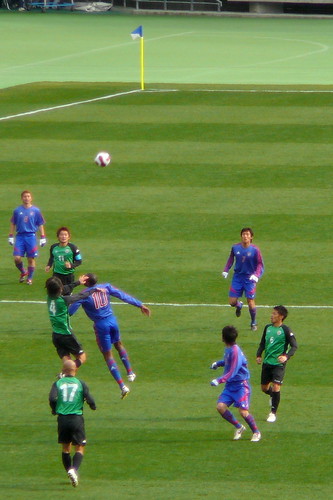 Crap Football Players
4. The Hakone Ekiden.
The Japanese love enduring hardship. Everybody knows that. So the marathon has a special place in the national psyche. An Ekiden is a race where a team of six runners each run a marathon one after the other in relay, covering hundreds of kilometers over several days, so it gets the Japanese going like nothing else. Most popular is the Hakone Ekiden, which starts in Tokyo on New Years Day and finishes in Hakone, the popular resort town to the Southwest. All the way the roads are lined with spectators, like the Tour de France, and there are bitter rivalries between the university teams who take part.
5. The Winter Olympics
Okay, so you can't always watch the winter olympics live in Japan. But watching it on TV is a most entertaining experience, because the commentators have such grossly overinflated expectations of how many medals Japan is going to win. At the last olympiad in Turin it was predicted that Japan would win some ten or more gold medals and a whole host of silver and bronzes; in fact for the first ten days or so they didn't win a single one. In each event, be it snowboarding, skiing or curling, Japanese athletes would get themselves ready and the commentators would ask each other for predictions and say things like "You have to expect gold or silver here," only for their dreams to be crushed seconds later in a tumble of snow and ice. One of my old work mates was massively into snowboarding and every day of the olympics' duration he would come into the office muttering "Just one medal, Dave - I at least expected one medal!" before I could even start with the jibes. He always looked so depressed it felt cruel to rub it in. I did, though.
Eventually they did get a gold. In women's ice skating.


