Have nothing booked holiday-wise this year; has been difficult to book something when I've been going after jobs and waiting on my examiners to tell me if my corrections are OK. I've been waiting for noisms to tell me if there is a good time to visit him in Japan sometime in September.
Now, thanks to a link from Boing Boing (which is fast becoming my favourite blog, and I know it's been around forever but I only started checking it about three weeks ago) I think I might just go to Japan in September regardless of whether noisms is free...
Basically, girls in cosplay dress guide you around Akihabara! Genius!
(also on Boing Boing, an interesting post about raising a chimp as a human...)
Showing posts with label japan. Show all posts
Showing posts with label japan. Show all posts
Wednesday, 23 July 2008
Holidays


Wednesday, 30 January 2008

Wednesday, 15 August 2007
Top 5 Japanese Sporting Events
So, in honour of zero_zero_one, who played his first game of football the other day, today's Japan Top 5 is all about sport. I should say, first of all, that I'm probably the exact opposite of my co-blogger, in that I love literally every sport you could name, and can quite happily sit all day watching or listening to whatever game happens to be on TV or the radio, especially if beer is also near at hand. Nothing can beat the live event, though, and Japan is a brilliant place to watch live sport; one of the things the country is less well known for is its rabid sporting enthusiasm - even if the Japanese remain charmingly incompetent at anything other than Judo and Sumo.
1. Yakult Swallows vs. Hanshin Tigers at Jingu Stadium.
Baseball is Japan's real national sport, and whenever I go to a baseball game in Japan I always think that it's a shame the Japanese didn't invent it. Not that the sport isn't a great American insitution and everything, but imagine it with lively brass bands playing military-style marches instead of the old organ, and flag-waving, and yakitori, and cute college girls serving beer, and fireworks, and everyone in the stadium standing up at the end of the 7th inning and blowing up balloons which they simultaneously let off to fly up into the night sky...
It has to be at Jingu stadium, too. Tokyo Dome is bigger, but the atmosphere is stilted - like Old Trafford; full of rich people 'slumming it' and keeping the real fans out. Jingu is old school - roofless, smelling faintly of beer, sweltering hot in the middle of summer so that the concrete itself seems to start sweating...and when Hanshin, the Osaka team come to town, it gets even hotter.
 Yakult Fans
2. The Natsu Basho at the Kokugikan.
Sport in Japan can't be mentioned without reference to Sumo. There are a lot of misconceptions about Sumo in the West; read about it in a guidebook to Japan and you'll get the impression that it's very arcane, mysterious and even semi-religious. Actually it's none of those things. Although there is a ritualistic build-up to each bout, it has no greater mystical significance than two wrestlers trash-talking each other before a WWE fight - it's all mean stares and wrinkled upper lips and chest-pounding before the fun begins. Then there is less than a minute of frantic, explosive power and energy - those guys look fat, but underneath they're built like Evander Holyfield - before one of them is thrown into the front row of the audience and the other struts back to his position to recieve a fat envelope full of cash.
Recently sumo has become dominated by Mongolians and Eastern Europeans (Russians, Georgian, Bulgarians and Czechs so far) so you get to see some fantastic grudge matches as the native, smaller Japanese guys try to take on the foreign invaders. It has all the intrigue and soap opera of WWE, and best of all, it's actually real.
 Sumo Wrestlers
3. A J-League Game
Compared to watching football in England, seeing it in Japan takes a bit of getting used to. For starters, they really are bad at it. Games are of such shockingly poor quality that if you approach them as an English football fan you'll spend most of the time with your head clasped firmly in your hands, muttering and cursing. The trick is to be Japanese about it: jump up and down, sing songs, wave flags, drink too much, and forget you know what the rules are or that people aren't supposed to take a shot on whenever they get within 30 yards of the goalmouth regardless of position.
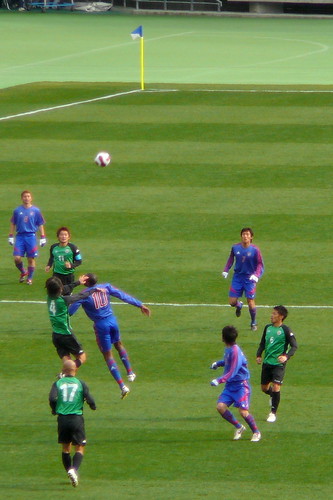 Crap Football Players
4. The Hakone Ekiden.
The Japanese love enduring hardship. Everybody knows that. So the marathon has a special place in the national psyche. An Ekiden is a race where a team of six runners each run a marathon one after the other in relay, covering hundreds of kilometers over several days, so it gets the Japanese going like nothing else. Most popular is the Hakone Ekiden, which starts in Tokyo on New Years Day and finishes in Hakone, the popular resort town to the Southwest. All the way the roads are lined with spectators, like the Tour de France, and there are bitter rivalries between the university teams who take part.
5. The Winter Olympics
Okay, so you can't always watch the winter olympics live in Japan. But watching it on TV is a most entertaining experience, because the commentators have such grossly overinflated expectations of how many medals Japan is going to win. At the last olympiad in Turin it was predicted that Japan would win some ten or more gold medals and a whole host of silver and bronzes; in fact for the first ten days or so they didn't win a single one. In each event, be it snowboarding, skiing or curling, Japanese athletes would get themselves ready and the commentators would ask each other for predictions and say things like "You have to expect gold or silver here," only for their dreams to be crushed seconds later in a tumble of snow and ice. One of my old work mates was massively into snowboarding and every day of the olympics' duration he would come into the office muttering "Just one medal, Dave - I at least expected one medal!" before I could even start with the jibes. He always looked so depressed it felt cruel to rub it in. I did, though.
Eventually they did get a gold. In women's ice skating.
Friday, 10 August 2007
Top 5 of Good Japanese Music
I don't much care for J-pop. I know that it isn't very fair or reasonable to call an entire genre "largely rubbish", but believe me. After four years in Japan spent listening to sub-Celine Dion melodramatic codswallop, faux- Will Smith rap-pop, and The Bends-era Radiohead without the tunes, riffs or lyrics, I feel I'm qualified to make that call.
But then again, a lot of Western pop music these days is rubbish too. That doesn't stop us finding bands which we like. And the same is naturally also true of the Japanese music scene. So here (drum roll) is my list of the Top 5 Japanese Bands Wot I Reckon You Should Check Out:
1. Elephant Kashimashi. A group of 80s survivors who've changed their style considerably over the years (and improved a lot: in 1988, when their first album was released, they were pretty awful). The singer, Miyamoto Hiroji, has one of the Great Rock Voices; a sort of throaty, bluesy version of Bono, but infinitely more expressive and tuneful than that, and the band are tight and somewhat experimental at the same time. More importantly, Miyamoto is one of the few Japanese leads to actually sing about interesting things and put an individual 'take' on them. (Japanese bands' lyrics tend to swing from one extreme to another - mindless 'I love you baby' drivel on the one hand, bizarre dadaist gibberish on the other.) That might not mean anything if you don't speak Japanese, but even you will be able to appreciate the fact that Miyamoto doesn't liberally sprinkle his songs with snippets of crushingly inappropriate and jarring English.
2. Jazztronik. I don't know about you, but I think the world needs more Music That Makes You Happy. And Jazztronik consistently manage that, without ever seeming like meaning to. That's just what the way the music comes out - you can actually hear the joy in it, like an extra instrument. I don't know whether J-jazz-funk-pop is a genre, but if it is, it's definitely my favourite.
3. Thee Michelle Gun Elephant. Do you remember the early 2000s Garage Rock renaissance? The Strokes, The Yeah Yeah Yeahs, The Vines, The Hives, Von Bondies, The Dirtbombs...well, Thee Michelle Gun Elephant had already revived it five or six years before, and are probably the only example of a Japanese band actually setting a trend rather than following one. What's more, they were also brilliant: loud, choppy guitars, gravelly but tuneful vocals, and a nice recognition that nothing else matters if you've got a really good riff.
4. I hate sounding like a sell-out, but I do really like Spitz, a band who formed in 1987 and are absolutely massive in Japan. Sometimes they sound too poppy for their own good (you know how some pretentious idiot musicians talk about "retaining their pop sensibilities"? well Spitz wouldn't have had that conversation because all they are is a bundle of pop sensibilities) but hooks like theirs are impossible to resist. Secret weapon is Kusano Masamune, the vocalist, whose eerily beautiful voice really doesn't sound like anything of this earth.
5. It's a bit of a cheat to include Oki, because his music is that of the Ainu, the indigenous people of Hokkaido (Japan's northernmost island). But I'll do it anyway, because I'm evangelical about how good Ainu music is/was. Even if you don't like 'world' music (I don't), it's worth listening to, and it'll surprise you firstly by how much it reminds you of the Blues (in the way it revolves around cyclical segments of rhythm) and secondly by how much you can hear the sound of Hokkaido - frozen lakes, pine forests, seal-hunting - in it, even if you've never been there. It's like the gateway to a subarctic world, right there on your ipod.


Thursday, 9 August 2007
I Blame Kill Bill
It's funny. In the time since I first arrived in Japan (March 2003), Japanese culture has really undergone something of a transformation. Before I left there were some upper-middle-class types in London who ate sushi for lunch, and there were some teenagers who read manga - mostly boys who liked looking at demons having sex with nubile high-school students - and of course, Pikachu was always lurking in the backwaters of our cultural byways like a sinister rumour. But Japanese fiction, art, cinema, comics and music remained very much a fringe interest.
Now it's no exaggeration to say Japaneseness is so popular that literally anything Japanese has become the watchword for coolness. Men - ordinary men, who shop at Top Man and drink lots of beer - strut around in old baseball shirts with Hanshin Tigers and Seibu Lions logos. Teenagers - and not just the geeky ones - read manga and think it's actually good. J-pop starlets like Hamasaki Ayumi and Koda Kumi are listened to. Miyazaki Hayao's films are hailed as masterpieces. Hollywood remakes Japanese horror films and considers it de rigeur to write Japanese characters into scripts. Films about Westerners struggling to make sense of how "baffling" Tokyo supposedly is win Academy Awards for Best Screenplay, even though they're really boring. Watanabe Ken is now an A-lister. Mamiko works in "The Japanese shop" and sells origami cranes for 60p a pop even though it takes her about three seconds to make one. The world has gone Japanese-mad.
Thinking back, the thing which either lit the touchpaper, or perhaps was just the first thing to signify the trend, was Kill Bill vol. 1. I remember coming back to the UK in around October 2003 for a visit and that film was everywhere, and the vast majority of the comment on it was of the nature of "I don't know about the story, but boy is Japan a cool place!" I think it rather skewed perceptions of what Japan is really like, with the way it seemlessly interwove bloodthirsty anime, female rock 'n' roll three-pieces, mafioso-style yakuza and Okinawan swordmakers into its plot. Even I, who knew that none of those things are remotely indicative of what life in Japan is like, watched that film and thought to myself "Japan is really damn cool."
The most interesting thing for me is that ordinary Japanese people are usually bemused when they hear about their country's newfound popularity. See, most Japanese people don't read much manga now but did when they were in junior high school, dislike Beat Takeshi films, think novels by Murakami Haruki and Yoshimoto Banana are generally kind of silly and depressing, don't know anything about origami and tea ceremonies, and vaguely recall Pikachu as some character who was popular ages ago and now think of in the same way that British people look back on Bananaman or Thundercats. If you tell them that now, for example, it wouldn't be considered unusual if an average British teenager plucked off the street could tell you what Cowboy BeBop is, they'd probably look at you askance and say "What's Cowboy BeBop?"
Anyway, over the next few days, I thought I'd post a few Top-5 lists of Japanese things which I think are worth investigating if, like me, you aren't particularly into samurai, ninja, manga, androgyny, slasher pics, suicidal novelists, pop stars who sing gibberish, pink things, girls who make 'peace' signs all the time in photographs, and cartoon characters with grotesquely large eyes.
First up tomorrow: music.
Wednesday, 27 June 2007
Child's Play
.
You can learn a lot from children's games. I've recently come across this picture, from Embracing Defeat, John Dower's masterful account of Japan during the American occupation:
.

The game was innocent enough - harmless mimicry like children's play all over the world - and it is notable how happy the kids in the picture look: despite the fact that older Japanese must have been deeply saddened by the spectacle, the game obviously served as a way for those involved to distract themselves from the drudgery of starvation, violence and misery in postwar Japan. The game itself was mixed with other forms of play, like runpen-gokko, in which the participants would pretend to be homeless vagrants, demo-asobi, in which they'd wave red flags like left-wing demonstrators, and, perhaps most bittersweet of all, kaidashi-gokko, "searching-for-food game".
First of all, we have to be careful not to paint the scene in too innocent a way. As Dower notes, "roundups of prostitutes included girls as young as fourteen, while schoolboys...quickly learned how to earn pocket money as pimps by leading GIs to women", he writes, indicating that innocent play often led to not-so-innocent practice as the children got older. But still, the picture leaves me feeling strangely optimistic. It tells me that progress, reform, and rebirth are possible.
There's a lot of angst in Britain these days about the state of the nation's youth, with UNICEF releasing a report placing Britain bottom of the heap in terms of child happiness in industrial countries, and almost daily stories detailing stabbings and gang violence amongst teenagers. But the picture shows that angst up for what it really is - just angst. Children are children, no matter what kind of lives they lead, and if the Japanese were able to mould their half-starved, war-weary, alchohol-addicted, poverty-stricken youth into the kind of people who could literally transform a nation, then I don't see why the British can't. All it takes is for adults to take responsibilty, to stop worrying, and go ahead and do it.
Subscribe to:
Posts (Atom)


