There is a certain meta-narrative of war these days that sees it as unremittingly brutalising, hellish and cruel. Mostly it stems from the Cold War, I think - all of those mean, nasty conflicts in places like Vietnam, Angola, El Salvador and Afghanistan were like hammer blows against the very profession of soldiery. It was Remembrance Sunday this week (I believe in other countries it's known as Armistice Day?) and a large part of the televisual programming revolved around the "War is Hell" motif - The Not Dead, a Channel 4 documentary last night, was a case in point. But you see it across Western culture generally: there is a large section of the population who will oppose any military action on the basis that war is always terrible and can never be justified. During NATO's Kosovo campaign, even, or the 2001 bombing of Afghanistan, huge swathes of the British public opposed the actions of the government - even though more black-and-white cases for war could hardly be made. The image we're presented with is that war basically involves lots of young men being completely dehumanised and irrevocably psychically wounded, and the whole thing is just too awful for words.
The reality must be more complex. We now know, for example, that Wilfred Owen - the quintessential 'anti-war' poet - wrote to his mother on returning to the front, and the thick of the fighting, in 1918, that he had "never been happier". (Siegfried Sassoon, another famous 'anti-war' poet, earned many medals for bravery and the nickname 'Mad Jack' for the eagerness with which he went over the top to fight Germans.) Many veterans find readjustment to their home life difficult not because they are traumatised, but because being a civilian is so boring compared to what they were previously doing.
My grandfather was a case in point. He joined the army at 16 (lying about his age) in 1939, found himself in a tank in Normandy in 1940, and was shot through both legs by a German machine-gun when bailing out of that tank after it had been crippled by an anti-tank gun. He was evacuated at Dunkirk, nursed back to health, rose to the rank of Corporal, and was on the beach at D-Day - from where he fought his way to the borders of Germany with the rest of the allied armies. He loved being a soldier and he loved the war - he loved it so much, in fact, that he re-enlisted as soon as it was over and fought in the Korean war, too.
I don't think for a second that he particularly enjoyed killing people. He was a friendly, peaceful and cool-tempered sort, who lived a basically decent life. But the vision of him proudly wearing his medals on Remembrance Sunday, visiting Normandy on regiment reunions, and painting his plastic airfix military models, just doesn't sit with the vision of war that we're asked to see by the zeitgeist of our times.
Perhaps it has something to do with the difference between a volunteer and a conscript. And of course, fighting the Wehrmacht or the Chinese Army as my grandfather did is not the same as massacring civilians in the killing fields of Angola or Mozambique - or being machine-gunned at the Somme. But I think it should be more often acknowledged that warfare is a considerably more complex beast than simply being "hell". That just doesn't properly explain the psychology of the thing, and why human beings - particularly male human beings - so readily become involved in it.
Tuesday, 13 November 2007
Doomed Youth?

Wednesday, 10 October 2007
The Countries That Never Were
I think one day I'd like to write a study on 'the nations that never were'. I've already spoken in this journal about Abkhazia, the erstwhile independent State of North-West Georgia, which has been de facto independent since the mid-90's but never quite managed to convince the world that it should actually be a State. (One of the little pecadillos of international law is that whether somewhere becomes recognised as a State or not depends mostly on flukes of history and realpolitik.) I was also recently reading at Strange Maps about Freistaat Flaschenhals, the so-called 'Free State of Bottleneck', that existed in the demilitarised Rhineland after the First World War. Sandwiched between the American and French zones of occupation into a bottleneck shape, it was notionally independent from the Weimar Republic, and even had its own stamps and passports.
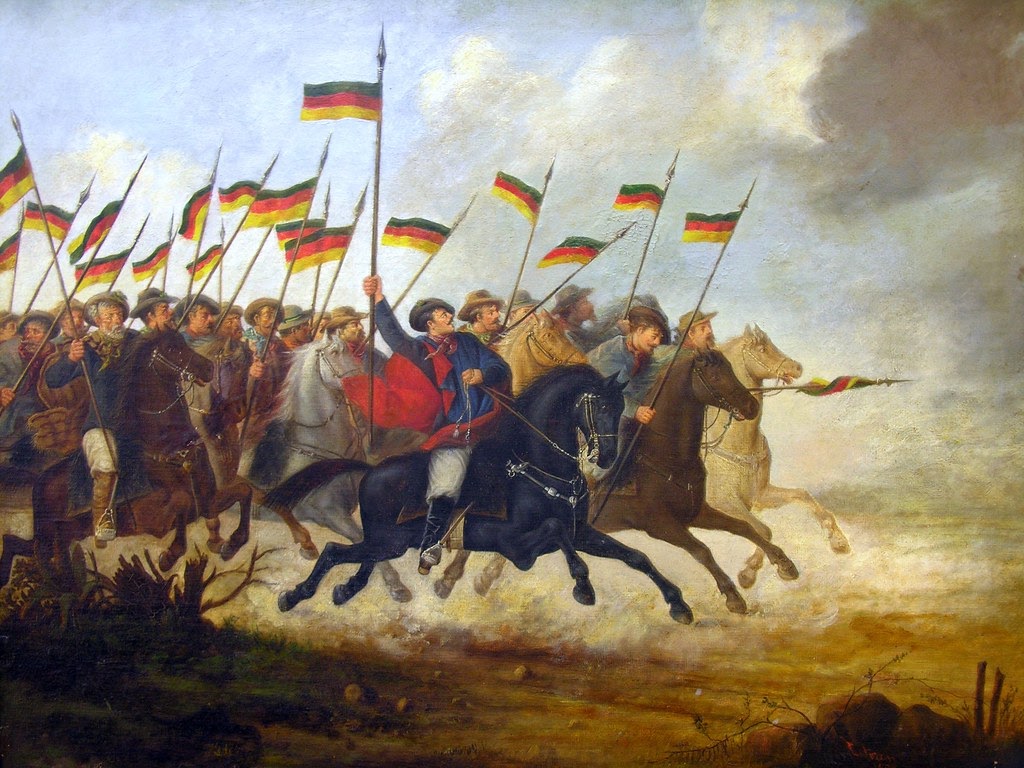
Most interesting for me, because it seems to have that air of romance about it that all stories of early Brazil have, is the Piratini Republic, centred in the modern-day Brazilian state of Rio Grande do Sul, which claimed independence from 1835-1845. The following War of Tatters, as it became known, is famous mostly because Guiseppe Garibaldi, who later was the driving forced behing the unification of Italy, became involved on the side of the rebels. But there is something almost movie-like in quality about the story of gauchos and cowboys fighting for their independence from the repressive government.
You'll notice from the painting that the men in question are carrying German flags. One of the reasons for the rebellion was that the people of the Brazilian south considered themselves ethnically different from the rest of the country, being mostly of German immigrant stock. Even today, the population of the state has a distinctly German character:
Anyway, my love of alternative history has been brought up before. I sometimes like to imagine what the world would have been like had the Piratini Republic or the Free State of the Bottleneck lasted. Probably not much different, but there would have been two more countries at the World Cup, at least.

Thursday, 20 September 2007
The Sex Lives of Us
Radio 4 have recently been running a series of programmes entitled The Sex Lives of Us, which aims to "explore sexuality in modern Britain". A bit of early morning titilation never hurt anyone, but I'm puzzled as to how some of the episodes have been billed.
Today, for example, we have Mariella Frostrup chairing a discussion on "whether our current propensity to start having sex earlier, more often and more randomly in the past means that we treat it as just another pastime rather than a duty to maintain the species". I mean: what?
Firstly, I've always been suspicious of claims that we now have sex earlier, more often and more randomly than in the past. I might be pursuaded to give you more randomly (more randomly than in the 1960s, though?), but how on earth does anybody know how often people in the past had sex? And the idea that people in modern Britain start earlier is preposterous: during the industrial revolution girls were commonly married by the age of 14. In the Victorian era and the 1950s people perhaps talked about sex less often, but that's hardly the same thing.
Secondly, when have human beings ever had sex out of "duty to maintain the species"? When has it ever not been an enjoyable pastime in its own right, that people want to do because it's pleasurable?
It seems utterly bizarre to suggest that at any time in the past people felt any "duty to maintain the species" - they might have felt a duty to maintain their family, but it seems more likely that they procreated for the same reasons we do: because of what children signify and the fulfilment they bring to a marriage. The underlying reason is, of course, because producing children is the way our genes copy themselves from one generation to the next. But even that isn't "maintaining the species": it's maintaining the DNA. And nobody has ever used that as the main reason for making love.
Sometimes I really do wonder about some people. Why assume that human beings fifty, a hundred or a thousand years ago were fundamentally any different in their attitudes and emotions than we are now?
Friday, 7 September 2007
Going AWOL
So I've left the blog to my old mucker zero_zero_one over the last few days. It's mainly due to a combination of trips to Dublin to sort out visas, job applications, and being all "writed out" from trying to finish off my damn thesis. Seriously, if I never have to read an article about cultural relativism again, it'll be too soon.
Anyway, I wasn't much impressed by Dublin, although I suspect it's one of those places that grows on you. What was most interesting about it was how similar it was to Glasgow and Liverpool - obviously the Irish connection. It had that same style of quietly magnificent Georgian architecture, the same mixture of poverty and new-found uber-development from European money, and the same sort of people - friendly and talkative but with an undercurrent of genuine steel.
It was especially similar to Liverpool in that it seems to rely heavily on past cultural glories for a sense of identity: in the case of Dublin it's James Joyce and W. B. Yeats; in the case of Liverpool, it's the Beatles and Roger McGough. Admittedly Dublin's references are slightly more highbrow. But there's the same sense of being defined more by the past than the future.
One thing about Dublin is that if you've studied a bit of Irish history you recognise most of the place names from dim memories of school text books. I enjoyed seeing Pheonix Park, site of the famous murders, for instance. It was also nice to be in the spiritual home of Irish Republicanism, given that my dad's side of the family are so into that aspect of Glasgow life, being Celtic-supporting mass-attending weejies. So I took a look around the Sinn Fein shop in honour of them, and also the Japanese connection, Shunsuke "He eats Chow Mein and he votes Sinn Feinn" Nakamura.
Wednesday, 29 August 2007
1949
One of the most astute observations that most astute observer, Milan Kundera, made, was that it is always the most banal discoveries that shock us the most. I was thinking about that earlier, while re-reading Embracing Defeat, a book I've written about in this blog before. It's a truism that during the Second World War and in its aftermath the world suffered incredible trauma on a scale never before experienced. And yet that banal fact still finds the capacity to be shocking in the most unexpected ways.
It was one paragraph that floored me. In the last weeks of the war, the Soviets declared war on Japan, and in a final desparate land grab, invaded Manchuria. The Japanese soldiers facing them were utterly demoralised, and the Soviet victory was absolute. Some 1.6 million Japanese were taken prisoner. By 1947 625,000 had been repatriated, but for years there was only silence from the the USSR regarding the rest, some of whom arrived, illegally, in dribs and drabs.
In the spring of 1949, Dower writes, after repeated prodding by occupation authorities, the USSR announced that only 95,000 prisoners remained, all of whom would be returned by the end of the year. According to Japanese and American calculations, the actual number should have been 400,000. Suddenly, more than 300,000 Japanese were unaccounted for. And here's the part that still has the capacity to shock: Over four decades later, the Soviet Union finally released the names of 46,000 Japanese known to be buried in Siberia. The overall numbers never jibed.
Dower goes on to say that "the fate of these Japanese is a neglected chapter among the countless epic tragedies of World War II," and he is undoubtedly right. What sorrow: over 200,000 men still formally unaccounted for, with families who never saw them again and yet never had the closure of knowing that their husbands, fathers, sons and brothers were dead and they could begin grieving. Who still, to this day, don't know what happened to them. I don't know how one could live with that unbearable not-knowing; obviously, thousands upon thousands of Japanese had to.
The saddest thing is that such cruelty was perpetuated so casually. It was as if it never occurred to the Soviet authorities that it might be possible to behave in a decent, humane way - that at the very least they might be able to provide some basic information that would console hundreds of thousands of devastated families. Instead their Japanese prisoners were consigned to oblivion without, apparently, a second thought, and their fates will never be uncovered.
Monday, 27 August 2007
More Linguistic Ramblings
Following on from my previous post, it appears that many words in Lithuanian and Sanskrit show surprising resemblances. According to the Wikipedia article, "the Lithuanian and Sanskrit words sūnus (son) and avis (sheep) are exactly the same, and many other word pairs differ only slightly, such as dūmas for smoke (dhumas in Sanskrit), antras for second (antaras in Sanskrit), and vilkas for wolf (vrkas in Sanskrit)."
Another of history's little surprises. Who would have thought that the Balts, for so long the last bastion of pagan belief in Europe, a nation of peasants living on the cold shores of a North European sea, should speak a language so similar to the speech of classical India and the Vedas?
Baltic Base
More ramblings on linguistics. I've become fascinated by the idea of proto-Indo-European, the tongue of a group of people who lived many thousands of years ago in Anatolia, India or the Ukraine (depending on who you read) and who eventually spread all across Europe and South Asia to make their language the ancestor to all the Indo-European ones we know today - Sanksrit, English, French, Latvian, Hindi, Sinhalese, Farsi, Albanian, Armenian, and all the rest.
What's most interesting is that linguists believe they can reconstruct this language through the techniques of comparative and Diachronic linguistics. By comparing words in various Indo-European languages and measuring how those words have changed through history, they can approximate what those words sounded like in proto-Indo-European. Examples include ekwos, horse; wodr, water; kwon, dog. The numerals 1-10 are thought to have been hoi-no, dwo, tri, k'etwor, penk'e, sweks, septm, okto, hinewn, and dekmt.
Surprisingly, the languages which are reckoned to be closest in character to proto-Indo-European today are Lithuanian and Latvian. That close pair, together with the now extinct Old Prussian, are extremely conservative languages - that is, they change little over time. It is thought that these modern day Balts are descendants of a group of people who left the Ukraine thousands of years ago and made their way to the Baltic Sea; they spoke a 'daughter language' of proto-Indo-European that has changed little since, diversifying slightly into the modern dialects we call Lithuanian and Latvian.
This makes me want to learn Lithuanian or Latvian. I've sometimes toyed with the idea of learning Gaelic, my ancestral language, but now I think hey, why stop there? Why not just go closer to the source? First I have to find a textbook on Lithuanian or Latvian and then I can get started...the question is: which should it be?
Friday, 24 August 2007
Forgotten Lessons
I've been reading about the Korean War recently. It seems obvious to the point of banality to point out, but the world has changed by a shocking extent in the fifty or so years since the war ended. Most noticeably, at that time Communism was seen as a perfidious evil, a threat to civilisation as we then knew it, to be resisted at all costs. The question in 1950 seemed not to be if a clash between the Soviet Union and the USA and its allies would occur, but when. Now Communism has been abandoned wholesale and its power to affect world events forever broken.
What's also noticeable is that the West's attitude to war and sacrifice has effectively U-turned. The USA lost 43,000 of its servicemen killed in the three years of war in Korea; Britain over 1,500. In Iraq the combined total for both nations approaches 4,000 after four years and is considered awfully high. Priorities have shifted, and now it seems that death in combat is something that is supposed to happen to people from other countries; never our own. When that myth is shattered we are shocked, as if combat deaths for British and Americans are tragedies rather than a natural and obvious consequence of war.
The Korean War also symbolises that old adage about those who forget the past being condemned to repeat it; the Korean War has often been called 'the forgotten war' and so we should expect that in its case the adage will be doubly true. Indeed this is so: the US military stormed into Korea expecting to sort out the 'gook' problem in a matter of weeks and then return to a life of luxury in occupied Japan, but instead during the summer of 1950 it suffered humiliating defeat at the hands of a vastly underestimated enemy which would take great sacrifice to overcome. That sounds like a fifty-year-old replay of the 2003 Iraq invasion and its aftermath, and just goes to reinforce the truism that the GOP hawks made a catastrophic mistake in those rudely optimistic days following the fall of Saddam.
But it also shows that the current 'stop the war' and 'troops out now' brigade could be equally misguided. A lot of the criticisms at the time of the Korean War could be echoed today: America was backing a corrupt and incompetent government without the support of the people; by staying it was doing more harm than good; in its insistence on the 'War on Communism' it was on a hiding to nothing. Fifty years on and those arguments seem ridiculous, even mendacious; thanks to the USA, Britain, Turkey, France and all those others who contributed troops, South Korea is now a free, wealthy, democratic society where it could have been just an extension of Kim Jong Il's personal fief. If the doves had had their way, today fifty million more Koreans would be being starved and brutally repressed instead of living in comfort.
I'm not sure what I believe about Iraq any more, but what I am sure of is that the modern opponents to the ongoing occupation are rather too certain that what they are arguing is the right thing. Similar voices were certain too during the Korean War, and fifty years have proved them wrong. Nobody knows what fifty years will tell us about the occupation of Iraq, but the lesson of Korea tells us that it's often more important to 'stay the course' than to turn and run. Probably the whole thing should never have happened, but now that it has we still have to make the best of it.

Tuesday, 7 August 2007
History Consigned to er...History
.
So History could disappear as an 'A' level subject, according to the BBC. Apparently the evidence for this is that it isn't compulsory after 14, whereupon two thirds of pupils drop it.
Honestly, this sort of thinking really does belong to...well, I was going to say "the dark ages" there, but that's not quite right. Let's say it belongs to the realm of ill-thought out assertions, instead.
For one thing, more people are studying history after 16 than ever before, which rather suggests the subject's in rude health. But leaving that aside, I love history, and I think it's the most interesting and important academic subject of them all, but I recognise that I'm in a minority on that point. Moreover, I'm aware of the fact that I detested maths at the age of 14, would have loved to have been able to ditch it at that point, and didn't learn a thing in my maths lessons between the ages of 14 and 16 because I spent the whole time playing hangman and talking about girls and dungeons and dragons with this guy called M. Bramley who used to sit next to me. I could have much more productively spent my time studying something I was interested in (like history). Consequently, I rather think its a good thing that kids who hate history and spend their history lessons playing hangman and talking about girls and dungeons and dragons (if they're as socially inept as I was) can give it up at 14 and do something else instead.
What makes me laugh about this report is that Ms. Tattersall is lamenting the fact that people drop history in favour of subjects like media studies and photography, which just make it "easier to get a job". Because, you know, studying things that make it easy to get a job is just, well...what's wrong with it, exactly?
*
I wonder if the fact that I used to like dungeons and dragons a whole lot has any relation to the fact that I couldn't find any girls who wanted to go out with me when I was between 14 and 16. Maybe thats why I just had to talk about them with M. Bramley instead.
Nah, can't be.
Wednesday, 25 July 2007
Red Sticks and Jacobites
I've recently become interested in what I've decided to christen the "things that make you go 'hmmm'" school of historical study: the way certain events - often barely noticed ones - from history can conspire odd and unexpected ways; ways that nobody could have predicted and which seem so incongruous and fitting as to have almost been planned by a fiction writer.
An example of this is the curious link between the Jacobite Rebellion of the Scottish Highlands and the Red Stick War of the Creeks against the United States government.
From the late 17th century to the mid-18th, Scottish independence from England took its last throw of the dice, when James VII and later Bonnie Prince Charlie launched insurgencies, with the aid of Highland Scottish clans, against the London government. A century of massacres, battle and guerilla warfare resulted, in which ancient Highland clan rivalries played as much a part as the question of independence, before finally the rebellion was ended at the 1746 Battle of Culloden. (My own genes played something of a role in the story: my grandmother was a member of Clan Campbell, a large and powerful Highland clan which sided with the government in the rebellion in order to settle long-held grudges against Clans Lohan, MacDonald and MacGregor.)
After the Jacobite Rebellion had been stamped out, the British government proceeded with a policy of ethnic cleansing (an anachronistic but appropriate term) in which Scottish Highland society and culture were effectively destroyed and in which large numbers of disposessed clansmen found themselves on ships bound for the New World. It's hard to imagine, these days, the situation of these men, plucked from an insular world of high, wet moorland, narrow valleys and deep dark lochs to the vast expanse of the Atlantic Ocean; our own experience of overseas travel is utterly alien to it. It must have been terrifying and awe-inspiring at the same time.
The place they found themselves in, on the opposite side of the planet, would, I think, have been surprisingly familiar. Native American society, with its tribalism, its clan bonds, and its endemic violence, wouldn't have been dissimilar to Highlands life; it's natural that the Scots would have made their ways to the frontiers, where they were often the vanguard of expansion.
Three of their descendants were to become a coterie of young leaders at the heart of the Creek nation at the turn of the 19th century: Menawa, William Weatherford (Red Eagle) and Peter McQueen, each half-Scottish, born to frontiersmen and Creek women, versed in both cultures, and often posessing startlingly incongruous eccentricities - like the regular playing of bagpipes before a battle. They came to prominence as the central force of the Red Stick movement - a group of young Creeks who believed in violent resistance to white expansion - which in 1812 began an insurgency against settlers, government forces and "civilized Creeks" in the Southern states. Massacre and guerilla warfare continued for some years before the rebellion reached its bloody conclusion at the Battle of Horseshoe Bend and its aftermath.
The parallels are obvious - both rebellions were categorised by slaughter of civilians (the Massacre at Glencoe and The Fort Mims Massacre); both were considerably more complicated than "native against government" (some Highlanders, like the men of Clan Campbell, fought for the British, and many Lower Creeks and Cherokees joined the US government against the Red Sticks - not to mention another Scots/Creek, William McIntosh); and, most sadly, both ended in the destruction of a way of life and an ancient culture. How interesting, though, and how like the plot of a novel, that it should be the very descendants of the Jacobites who should go on to be the driving force of the Red Sticks, in a land thousands of miles away and as ostensibly far removed as possible, and that their experience should be so similar.
Makes you go 'hmmm', see?


Friday, 29 June 2007
So-called "Experts"
.
So-called experts say some stupid things. I've just been reading this article, in which Akbar Ahmed, "one of the world's leading authorities on Islam", sets out the ways in which the West and Islam can "overcome the huge chasm" that exists between them. In his mind, it's all about education for both sides - overcoming ignorance and fear and learning to work together.
All very unobjectionable stuff, but he then goes on to make the bizarre statement that "It's not just 9/11. It started in the 19th century when the first clashes between the west and Islam took place" [emphasis added].
Yeah, I didn't think I'd read it correctly, either. The 19th Century. Has "one of the world's leading authorities on Islam" never heard about the Crusades? The Reconquista? The Battle of Tours? Does he really think that the first clashes between the West and Islam were a mere hundred and fifty years ago?
Very strange; Akbar obviously knows that he's misrepresenting the truth with that statement, because he can't possible believe it's true, but in which case, why lie? You would think that, when calling for greater education about a subject, you wouldn't tell obvious mistruths about it from the other side of your mouth.
I wish I had greater insight into why he said what he did, but The Guardian article doesn't shed any more light. It's just...odd. Why pretend that the West and Islam didn't clash until the 19th century? Is he engaged in revisionism; trying to make us forget that Muslims once aimed to take over the world? Or is he trying to make us think that the West, once upon a time, looked on Islam as a busom buddy, and can do so again in the future?
It reminds me that most "experts", especially the ones who appear on TV and in newspaper articles, don't really have much more authority to comment on a given subject than you or me. Best to ignore them, I think, and make up one's own mind.
Thursday, 28 June 2007
Amiable Frenchmen
.
I sometimes wonder what the world would have been like had England failed in its attempt at world domination in the 18th and 19th centuries. Portugal, Spain, Holland and France all had their chances to rule the world. Germany, Belgium, Japan and Russia put in some good showings. And that isn't to mention the Third Division of the Colonisation League, comprising Italy, the almost-nowadays-unknown colonial empires of Denmark and Sweden, and complete obscurities like Courland.
The world would have been a more interesting, and richer, place, I think. For starters, the French especially were reknowned for being much more willing to cooperate with Native Americans as equals, and if they'd kept control of Canada and Louisiana we might have seen a very different, more recognisably native North America emerging. India might never have suffered the ignominy of complete subjugation if Britain had not won at Plassey, and a subcontinent that was a mixture of indigenous polities like Mysore, Hyderabad, Jodhpur and Maharashtra, and European-founded city-states like Portuguese Goa, French Pondicherry, British Calcutta, Danish Serampure and Dutch Masulipatam, would now exist. Indigenous Alaskans would worship in Russian Orthodox churches. The world would be an utterly different place.
More importantly, for my purposes, the Australians wouldn't be around to make lousy day-time Soap Operas, because they might very well have been busy speaking French instead - hanging out at pavement cafes, smoking too much, having great sex, and drinking Chateauneuf-de-Pape rather than Castlemaine XXXX. This is because a certain "amiable Frenchman" (as described by Bill Bryson in Down Under) by the endearingly ornate, pre-revolutionary name of Jean-Francois de Galaup, comte de La Perouse, could very well have got there first and claimed Australia for France. As it was he arrived just after the first motley collection of cockney criminals, under Captain Phillip, had started to disembark in Botany Bay. Bryson captures the event rather nicely: "La Perouse's expression when it was explained to him that Phillip and his crew had just sailed 15,000 miles to make a prison for people who had stolen lace and ribbons, some cucumber plants, and a book on Tobago, must have been one of the great looks in history, but alas there is no record of it."
He then goes on to note, drily, that if only La Perouse had arrived a little earlier, he could have saved the continent 200 years of English cooking. Sport lovers among us will be more interested in the fact that it would have saved us English years of humiliation on the cricket pitch, too.


